
QForm for Forging & Rolling: Eliminating Trial-and-Error
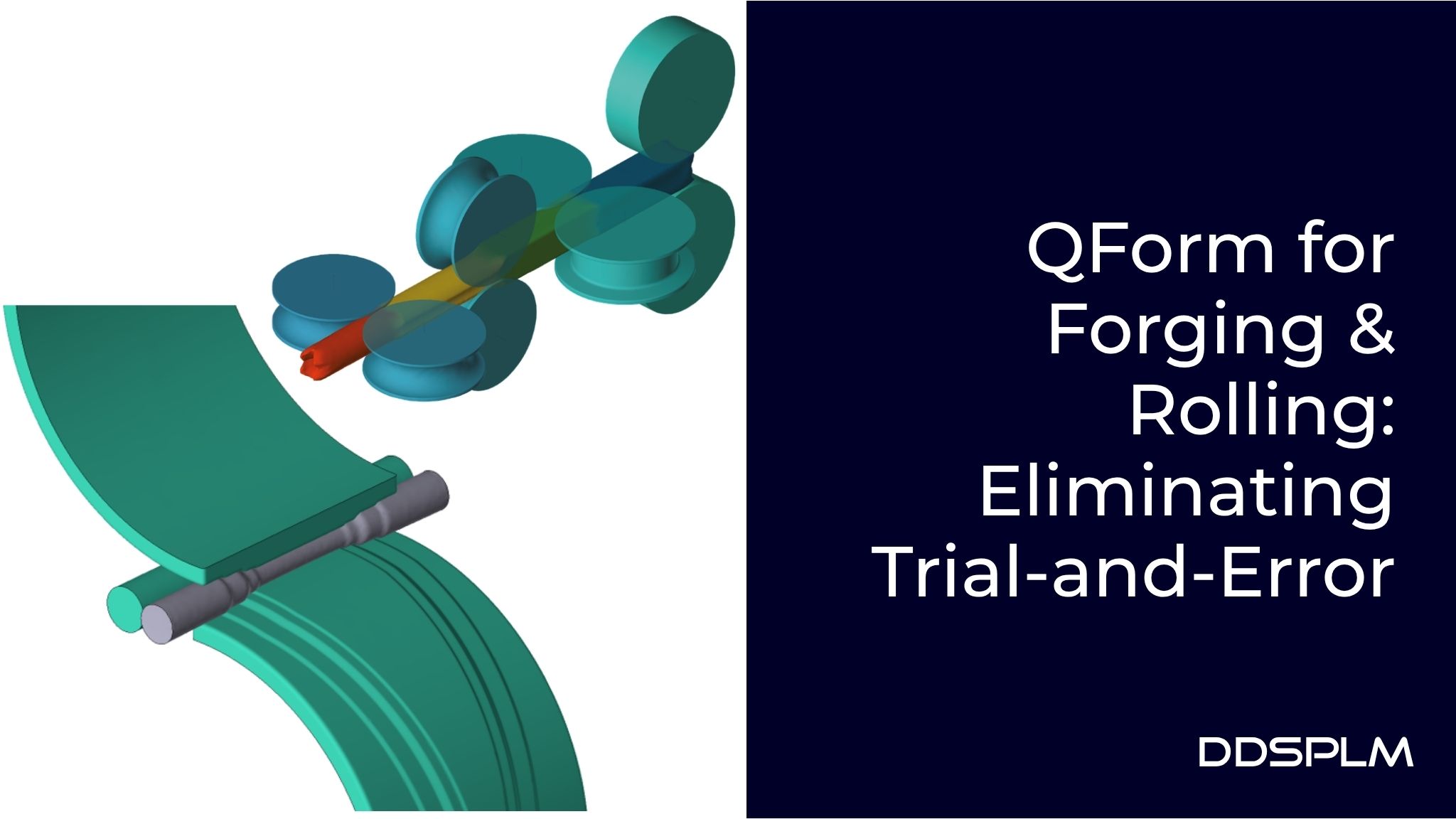
Walk into almost any forge and you'll see the same pattern: a new die is cut, a trial batch is run on the press, a defect or underfill shows up, the die goes back for rework, and the cycle repeats. Every iteration consumes steel, machine time, and days before a part is ready for production. Forging and rolling shops have worked this way for decades — but they no longer have to.
The real cost of "cut and try"
Trial dies are expensive. A single die correction can require re-machining, re-heat-treating, and re-testing of trial parts — costing anywhere from a few thousand to many thousands of rupees per correction, depending on part complexity and material. Multiply that across a typical three-to-five-iteration development program and "cut and try" becomes a major share of total tooling cost.
The bigger cost, though, is time. A forge shop that needs six weeks of trial-and-error to get a die right is at a serious disadvantage to one that gets it right in the first two attempts.
What QForm does
QForm is a simulation platform built specifically for forging and rolling — not a general-purpose CAE tool, but software grounded in the physics of hot and cold bulk-forming processes. By simulating ahead of production, engineers can watch the entire forming process on screen and see, virtually, the defects that would otherwise appear on the shop floor:
- Material flow and die fill — see how the billet flows through the die at each stage, preventing underfill and flow-line defects.
- Fold and lap prediction — detect folds and laps, defects that are otherwise hard to catch until final inspection.
- Force and energy prediction — size the press correctly and avoid overloading equipment.
- Stress and wear analysis — predict where dies will wear or break under repeated cycles, extending tool life.
- Thermal gradients — track temperature through multi-stage hot forging, which is critical for metallurgy and die life.
- Microstructure and grain flow — final part properties depend on the forming process, not just the geometry.
The result: optimized forging, rolling, and other bulk-forming processes. Because simulations run quickly, engineers can test several die-design concepts in the time it would take to machine a single die.
From the shop floor to the screen
The real shift QForm enables is where errors are found. Instead of discovering a flow defect on the press — after steel, energy, and machine hours are already spent — the defect appears on a screen during the design phase, where fixing it costs engineering time but no steel, energy, or machine time. That matters most in several situations:
Multi-stage forging sequences. Complex components — automotive steering parts, crankshafts, connecting rods, flanges — usually need several forming steps (blocker, finisher, trimming). A misformed preform at the first stage causes problems at every stage that follows. With QForm, engineers optimize the whole sequence at once, rather than physically tuning each stage in turn.
Qualifying a new material or alloy. When a customer requests a different alloy or tighter tolerance, "rule of thumb" die designs may not transfer. Simulation lets engineers evaluate the new material's flow without investing in tooling.
Optimizing die life and cost. Beyond getting a good part on the first try, QForm's die stress and wear prediction supports a proactive approach to part cost — improving cost-per-part across a production run rather than reacting after problems appear.
Rolling process design. QForm applies the same simulation-first principle to roll-pass design, helping engineers develop the optimal pass sequence for dimensional tolerance and surface quality — without wasting mill hours on trial passes.
What it means for the business
The benefits of eliminating trial-and-error aren't just engineering wins — they show up on the balance sheet:
- Fewer trial dies mean lower tooling cost per program.
- Faster time to production enables quicker responses to OEM RFQs and shorter lead times on new business.
- Predictable die life reduces unplanned downtime and improves maintenance planning.
- Right-first-time quality minimizes scrap and rework — increasingly important as tolerance requirements tighten across automotive and machinery forgings.
For a forge shop competing with larger, better-capitalized rivals, simulation-driven die design is becoming the edge that wins or loses a program.
Getting started
Adopting simulation isn't all-or-nothing. Most forge shops begin with a single high-value or high-defect-rate part, validate QForm against reliable trial data from their own presses, and grow from there once the approach is proven. DDSPLM's engineering team co-develops exactly this kind of pilot with customers — not just a demo model, but validation against real production parts before rolling simulation out across the design process.
When you're still developing dies by trial and error, the question isn't whether simulation pays for itself — it's how many trial dies you're willing to cut before simulation gives you the answer. Explore our forging simulation services or talk to our team.
← Back to all posts